
AI Content Engines: Create Marketing Without Burning Out
You Know You Need to Post More. You Just Don't Have the Time.
Every marketing article tells you the same thing: publish consistently. Blog weekly. Post on social daily. Send email newsletters. Create video content. Engage with your audience.
All true. All effective. All completely unsustainable if you're running an actual business.
You're not a content creator. You're a contractor, consultant, service provider, or business owner. Your job is to serve customers, manage operations, and grow revenue. Not spend 10 hours a week writing blog posts and scheduling Instagram captions.
But here's the problem: businesses that publish consistently get more leads. They rank better in search. They stay top of mind. They build authority. The companies that go silent for months at a time get forgotten.
So you're stuck. You need content. You don't have time to create it. Hiring a full-time writer or agency costs thousands per month. DIY content takes hours you don't have and produces mediocre results.
This is exactly what AI content engines solve.
Not generic ChatGPT outputs that sound robotic and repetitive. Not lazy automation that publishes garbage. Real content systems that generate high-quality, on-brand material tailored to your business, your audience, and your goals.
Here's how they work and why they're changing the game for small businesses.
What an AI Content Engine Actually Does
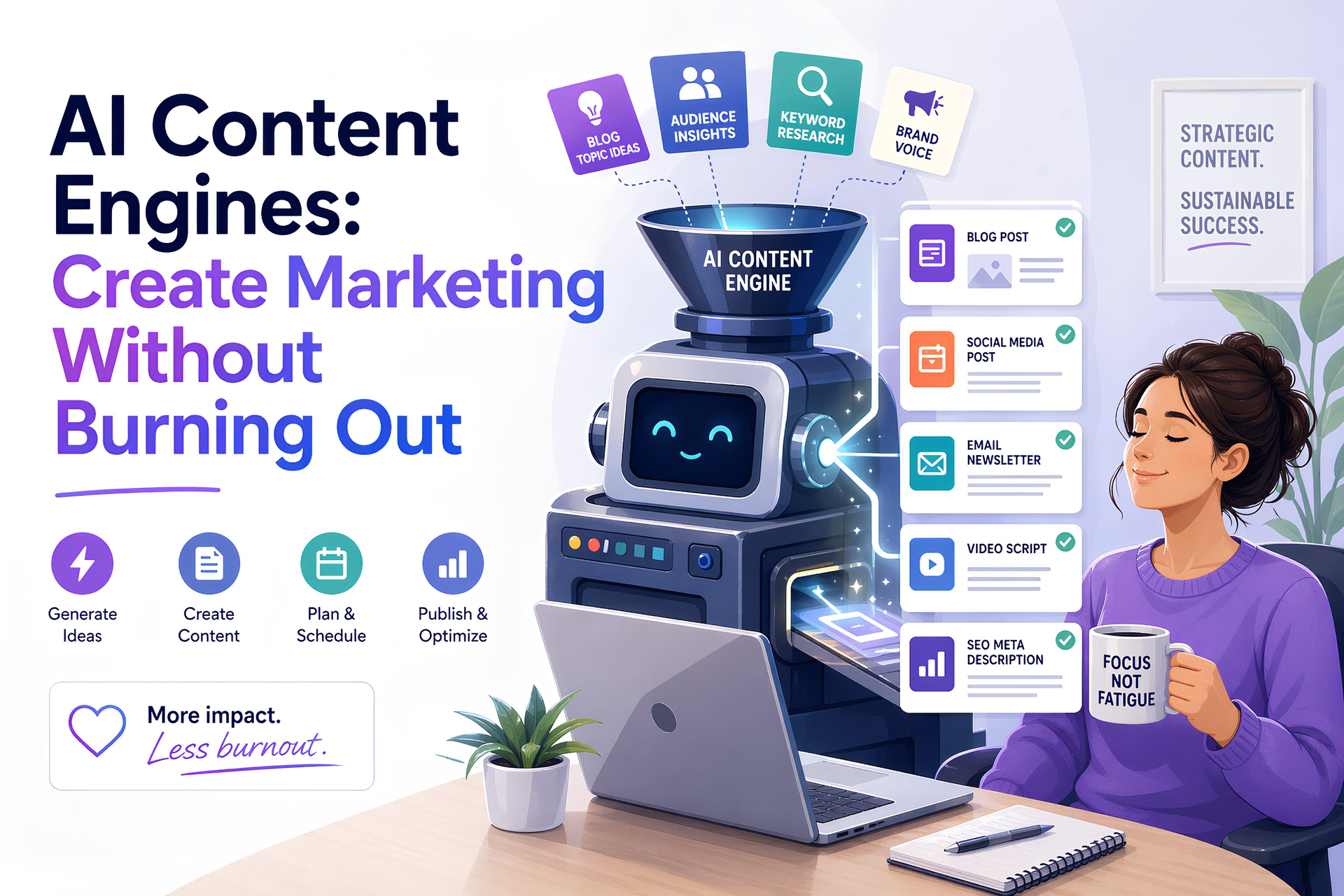
An AI content engine isn't a single tool. It's a workflow. A system that uses AI to research, write, optimize, and publish content across multiple channels without requiring constant manual input.
Think of it like this: you set the strategy once. The system executes it repeatedly.
Here's what a properly built content engine handles:
Blog posts. Research topics based on your industry, customer questions, and keyword opportunities. Generate well-structured articles optimized for SEO and AI search. Publish them on schedule without you writing a single word.
Email campaigns. Draft newsletters, promotional emails, and follow-up sequences based on customer behavior and business goals. Personalize messaging without manual segmentation.
Social media posts. Create captions, headlines, and content ideas tailored to each platform. Schedule posts across LinkedIn, Facebook, Instagram, and Twitter. Maintain consistent presence without daily effort.
Google Business Profile updates. Generate posts, offers, and announcements that keep your profile active and improve local visibility. Regular GBP activity signals to Google (and AI search tools) that your business is engaged.
Lead nurturing sequences. Automatically send educational content, case studies, and offers to leads based on where they are in the buying process. Keep prospects engaged without manual follow-up.
The goal isn't to replace human creativity. It's to eliminate the repetitive, time-consuming tasks that drain your energy and keep you from focusing on what actually moves your business forward.
A well-designed content creation system uses AI to handle the heavy lifting while you maintain control over strategy, tone, and messaging.
Why Manual Content Creation Doesn't Scale
Let's be honest about what manual content creation actually looks like for most small businesses:
You sit down once a month with good intentions. You brainstorm blog ideas. You start writing. Two hours later, you've got 300 words and six unfinished drafts. You get pulled into a client call. The blog sits unfinished for three weeks.
Or you batch-create content on a Sunday. Spend the entire day writing, editing, formatting, and scheduling posts. By the end, you're exhausted and swear you'll never do it again. Two months later, your queue is empty and you're scrambling to post something, anything, just to stay visible.
Or you hire a freelancer. They write a few decent posts, then disappear. You hire someone else. The quality is inconsistent. The tone doesn't match your brand. You end up rewriting everything yourself, which defeats the purpose.
Manual content creation has three fatal flaws:
It's too slow. Writing, editing, and publishing a single blog post takes 3 to 5 hours if you're doing it right. Multiply that by weekly posts and you're spending 12 to 20 hours per month on content alone.
It's inconsistent. Life happens. Busy weeks derail your content calendar. Your audience notices when you go silent. Inconsistency kills momentum.
It doesn't scale. Want to publish more? You need more time or more money. There's no leverage. You're trading hours for output.
AI content engines flip this. They don't get tired. They don't miss deadlines. They scale infinitely without additional cost.
How AI Content Engines Maintain Quality (Without Sounding Like Robots)
The biggest objection to AI content is quality. And it's valid.
Poorly configured AI tools produce generic, repetitive, keyword-stuffed garbage that sounds like it was written by a chatbot. Because it was.
But that's not an AI problem. It's a system design problem.
AI is a tool. Like any tool, it produces results based on how it's used. A poorly trained AI with vague prompts generates poor content. A well-configured system with clear inputs, brand voice guidelines, and quality controls produces content indistinguishable from human-written material.
Here's what separates good AI content systems from bad ones:
Custom training on your brand voice. AI learns how you communicate. Your tone, your phrasing, your style. It doesn't sound generic because it's trained on your existing content, not random internet text.
Topic research and keyword targeting. Good content engines don't guess. They analyze search trends, competitor content, and customer questions to identify what your audience actually wants to read.
Structured workflows with human oversight. AI drafts. Humans review, refine, and approve. The system handles 80% of the work. You handle the final 20% that ensures quality and accuracy.
SEO and AI search optimization. Content is structured for both traditional search engines and AI-powered tools like Google SGE, ChatGPT, and Perplexity. Headers, summaries, and natural language make your content easy to index and cite.
Integration with your website and platforms. Content doesn't just sit in a Google Doc. It's published automatically to your blog, formatted for readability, and optimized for mobile. Your custom website design stays fresh without manual uploads.
Quality AI content isn't about letting robots write everything. It's about using automation to eliminate grunt work while maintaining editorial control over what gets published.
The Real ROI: Time, Consistency, and Visibility
Let's talk numbers.
If you're spending 10 hours per month creating content manually, that's 120 hours per year. If your time is worth $100 per hour (and it should be), you're investing $12,000 annually in content creation.
An AI content engine costs a fraction of that. And it doesn't just save time. It improves results.
Consistency drives SEO. Google rewards websites that publish regularly. Fresh content signals relevance. An active blog with weekly posts ranks higher than one that publishes sporadically. Automated systems ensure you never go silent.
Content compounds over time. Every blog post, email, and social update is a long-term asset. AI-generated content builds a library of searchable, shareable material that continues driving traffic and leads months (and years) after publication.
More content means more touchpoints. The businesses that stay top of mind are the ones showing up consistently. Blog posts, emails, social updates, Google Business Profile posts. Every touchpoint is an opportunity to convert a prospect into a customer.
Automation frees you to focus on revenue. Time spent writing blog posts is time not spent closing deals, serving customers, or growing your business. AI content engines handle the background noise so you can focus on what actually makes money.
The ROI isn't just financial. It's mental. You're not stressed about content calendars. You're not scrambling to post something last-minute. You're not sacrificing weekends to batch-create content.
The system runs. You focus on your business.
What AI Content Engines Can't (And Shouldn't) Replace
AI is powerful, but it's not magic. There are things it can't do and shouldn't try to replace.
Original expertise and insights. AI can research and synthesize information, but it can't replace your lived experience. Case studies, client stories, and unique perspectives still require human input.
Complex strategy and positioning. AI can execute a content plan, but it can't create one from scratch. You still need to define your messaging, target audience, and business goals.
Personalized client communication. Automated emails and follow-ups work for lead nurturing, but high-value client relationships still need personal attention. AI supports your outreach. It doesn't replace it.
Creative storytelling and brand differentiation. AI can write compelling copy, but truly unique brand stories come from human creativity. Use AI for execution. Reserve human effort for the work that sets you apart.
The smartest approach is hybrid: AI handles repetitive, scalable tasks. You focus on high-impact work that requires judgment, creativity, and personal connection.
How to Build (Or Buy) an AI Content Engine
You have two options: build it yourself or hire someone to set it up for you.
Building it yourself requires technical knowledge, time, and trial and error. You'll need to choose tools (ChatGPT, Jasper, Copy.ai, n8n, Zapier), configure workflows, train the AI on your brand voice, and test outputs for quality. It's doable, but expect to invest 20 to 40 hours upfront and ongoing tweaking as you refine the system.
Hiring an expert means you get a turnkey solution. An agency or specialist builds the entire workflow, trains it on your content, integrates it with your website and platforms, and provides ongoing support. You pay for expertise and speed. The system is live in days, not months.
Either way, the key is integration. Your content engine should connect to your website, email platform, social media accounts, and CRM. Content should flow automatically from creation to publication without manual intervention.
AI automation services can build content engines tailored to your business, ensuring quality, consistency, and scalability without requiring you to become a prompt engineer.
What Happens If You Keep Doing It Manually
Content marketing isn't optional anymore. It's table stakes.
Your competitors are publishing. They're staying visible. They're building authority. If you're silent, you're losing ground.
Manual content creation worked when competition was lower and customer expectations were different. In 2026, people expect businesses to be active, engaged, and helpful. They research before they buy. They compare options. They read reviews, blogs, and social posts before making decisions.
If your content strategy is "post when I have time," you don't have a strategy. You have a hope.
AI content engines don't just save time. They level the playing field. Small businesses can compete with larger competitors by publishing consistently, ranking in search, and staying visible without hiring full-time content teams.
The businesses that adopt AI content automation early will dominate their markets. The ones that wait will spend the next two years playing catch-up.
See How an AI Content Engine Could Work for Your Business
We're offering free website audits that include a content strategy assessment. We'll show you where your current content is working, where it's failing, and how an AI content engine could fill the gaps without adding hours to your workload.
No pitch. No obligation. Just a clear breakdown of what's possible and what it would take to implement.
You can keep doing content manually and burning out. Or you can automate it and focus on running your business.
The choice is yours.






Need Help Growing Your Business Online?
We offer website design, SEO, and AI automation services for Palm Beach County businesses.